Recent Post

CRA Business Registration Online: 2026 Simplified Guide for Canadian Businesses
Starting a business in Canada comes with many decisions. You…

T2125 Form Explained: A Guide for Small Business Owners
You started your business because you wanted freedom and control….

CRA Audit in Canada: A Guide for Small Businesses
A letter from the Canada Revenue Agency can make your…
Modern Bookkeeping Practices That Save Time and Improve Accuracy
Bookkeeping has evolved significantly over the past decade. Businesses no…
If you’ve ever stared at your T1 return wondering why there are two different income numbers on it, you’re not alone. Line 10100 and line 15000 both show up in the income section, both look like they should represent “how much you made,” and yet they’re rarely explained side by side. Here’s the short version, then the full breakdown.
Quick answer: Line 10100 is your employment income only — the total from Box 14 of your T4 slip(s). Line 15000 is your total income from every source: employment, self-employment, pensions, EI, investments, rental income, and more. Line 10100 is one of the ingredients that gets added up to produce line 15000. If your only income came from a job, the two numbers will match exactly. The moment you add a side hustle, investment income, or a pension, they’ll start to diverge.
What Is Line 10100 on a Tax Return?
Line 10100 is where you report the employment income you earned as a T4 employee. It used to be called line 101 before the CRA switched to five-digit line numbers in 2019, so if you’re comparing an old return to a new one, they’re the same thing.
The number itself comes straight from Box 14 on your T4 slip — the box labeled “Employment income.” If you worked for two or three employers during the year and got multiple T4s, you don’t pick one; you add every Box 14 amount together and put the combined total on line 10100.
A few things that do belong here:
- Salary and hourly wages
- Bonuses and commissions
- Vacation pay
- Taxable benefits your employer reported on the T4
A few things that don’t belong here:
- Tips or cash income not shown on a T4 (that goes on line 10400 instead)
- Self-employment or freelance income (that goes through the T2125 form and lands on the business income lines, not 10100)
- Fees for services reported in Box 048 of a T4A
If line 10100 is blank on your return, it usually just means you had no T4 employment income that year — not that something went wrong.
What Is Line 15000 on a Tax Return?
Line 15000 is your total income for the year, before any deductions are subtracted. Think of it as the finish line of “Step 2 – Total Income” on the T1 General form. Every income line above it — employment, pensions, EI, dividends, interest, rental income, capital gains, and so on — gets added together, and the sum lands on line 15000.
You don’t calculate this one by hand. Your tax software, or the CRA if you file on paper, adds up all the individual income lines automatically once you’ve entered your slips. Line 15000 used to be called line 150, so older documents and Notices of Assessment may still refer to it that way.
This number matters well beyond your tax bill. Lenders ask for it to assess mortgage or loan applications. Courts use it to calculate child or spousal support. And it’s the starting point the CRA uses to figure out how much you’ll get from benefits like the Canada Child Benefit or the GST/HST credit, since those are based on net and family income calculations that begin with line 15000.
Line 10100 vs Line 15000: The Core Difference
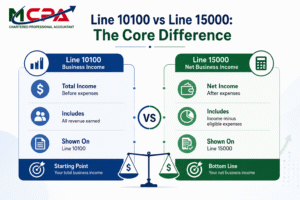
Here’s the simplest way to picture it: line 10100 is one ingredient, and line 15000 is the finished dish. Line 10100 answers “how much did my job pay me?” Line 15000 answers “how much did I earn from everything, period?”
| Feature | Line 10100 | Line 15000 |
|---|---|---|
| What it reports | Employment income only | Total income, all sources |
| Where it comes from | Box 14 of your T4 slip(s) | Sum of lines 10100 through 14700 |
| Also known as | Formerly line 101 | Formerly line 150 |
| Manually entered? | Yes, you add up your T4s | No, calculated automatically |
| Used for | Confirming employment earnings | Benefit eligibility, loans, support payments, CRA identity verification |
Because line 10100 feeds directly into line 15000, an error in your T4 entry doesn’t just throw off one number — it throws off every calculation downstream, including your eligibility for credits and benefits.
Where Is Line 15000 on a T4?
This one trips up a lot of people, so it’s worth saying plainly: line 15000 doesn’t appear on your T4 at all. A T4 slip only reports what a single employer paid you — that number feeds into line 10100, not line 15000 directly. Line 15000 only exists on your T1 Income Tax and Benefit Return, once every income source (not just your T4s) has been added up.
You’ll find line 15000 in one of three places:
- On your filed T1 return, at the bottom of the “Total Income” section
- On your CRA Notice of Assessment, after your return has been processed
- In your CRA My Account, under your filed returns
If someone has asked you for your “line 15000” and all you have on hand is a T4, that slip alone won’t give you the right figure unless employment was your only income source for the year.
When Do These Two Lines Match — and When Do They Split?
For a lot of people, especially those with one job and no other income, line 10100 and line 15000 are the exact same number. There’s nothing else being added, so the “ingredient” and the “finished dish” are identical.
They start to diverge the moment you have more than one income source. Common reasons the two numbers won’t match:
- You collected EI benefits at some point during the year
- You have investment income from a T5 or T3 slip
- You receive a pension, CPP, or OAS
- You have rental income
- You’re self-employed in addition to a T4 job
- You received RRSP withdrawals
In every one of these cases, line 15000 will be higher than line 10100, because it’s capturing everything, not just the paycheque.
Why Getting This Right Matters
Mixing these two lines up, or missing income when your tax software calculates line 15000, isn’t a small clerical issue. An inaccurate line 15000 can delay your refund, trigger a CRA reassessment, or throw off your Canada Child Benefit and GST/HST credit amounts, since both are based on your total income figure. If you’re applying for a mortgage or being asked for proof of income for a loan, lenders will typically ask for line 15000 specifically, not line 10100, because they want the full picture of what you earn.
Frequently Asked Questions
What is line 10100 on a tax return?
Line 10100 is the line on your Canadian T1 return where you report employment income — the total from Box 14 of your T4 slip(s). If you had more than one employer, you add all your Box 14 amounts together.
What is line 15000 on a tax return?
Line 15000 is your total income for the year from every source combined: employment, self-employment, pensions, EI, investments, and rental income. It’s calculated automatically and sits at the bottom of the “Total Income” section on your T1.
Is line 10100 the same as line 15000?
Only if employment was your sole income source for the year. Line 10100 is just one part of line 15000, so as soon as you add other income, the two numbers will no longer match, with line 15000 being the higher figure.
Where is line 15000 on a T4?
It isn’t on a T4 at all. A T4 slip only shows what one employer paid you, which feeds into line 10100. Line 15000 only appears on your T1 return, your CRA Notice of Assessment, or in CRA My Account.
What is line 10100 CRA, and where do I find it?
It’s the CRA’s designated line for reporting employment income on the T1 General return. You’ll find it in Step 2 of the form, and it’s calculated by adding up Box 14 from each of your T4 slips.
How do I calculate line 15000 on my tax return in Canada?
You don’t calculate it manually. Your tax software, or the CRA if you file on paper, adds up every income line above it, including line 10100, and enters the total automatically once you’ve entered all your slips.
Why does line 15000 matter more than line 10100 for benefits and loans?
Because it reflects your full financial picture, not just your job. The CRA uses line 15000 to determine eligibility for benefits like the Canada Child Benefit and GST/HST credit, and lenders typically request it for mortgage or loan applications.
Quick Recap
- Line 10100 = employment income only, pulled from Box 14 of your T4(s)
- Line 15000 = total income from every source, calculated automatically
- They’re equal only when a job is your sole income source
- Line 15000 is not found on a T4 — it only exists on your T1 return, NOA, or CRA My Account
- Errors on line 10100 ripple through to line 15000 and everything that depends on it
If your return only has one T4 and nothing else, you can stop worrying about the difference — the two numbers are the same thing wearing different hats. Once other income enters the picture, keep them straight, because the CRA, your lender, and any benefit calculation will care about which one they’re looking at.